
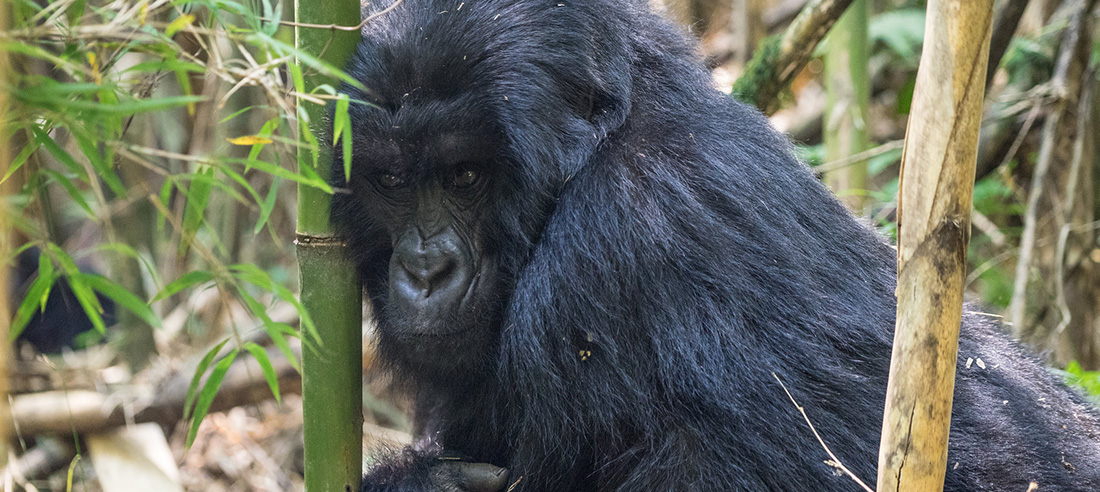
Facts About Gorillas
Many travellers across the World might not be able to differentiate between gorillas and Chimpanzees or even the different gorilla sub-species but one thing for sure is that these Great Apes are one of the most sought-after creatures on Earth. The following are the interesting facts about gorillas that will make you fall in love with them and leave lifetime memories.
Gorilla species
There are presently two recognized gorilla species-the Eastern gorillas that are also sub-categorized into the mountain and Eastern lowland gorillas as well as the western gorillas that are also sub-divided into the Cross River and western lowland gorillas. These gorilla sub-species occupy different habitats in the African Continent.
Gorilla habitats and distribution
The natural habitats of gorillas are mainly marked by Tropical or sub-tropical rainforests within the sub-Saharan Africa and while their range covers a small portion of Sub-Saharan Africa, these primates occupy varying altitudes. For instance, the mountain gorillas live within the Albertine Rift montane Cloud forests along the slopes of Virunga Volcanoes (Uganda, Rwanda and Democratic Republic of Congo) and hilly areas of south-western Uganda within elevations of 2500 and 4000 meters above sea level.
The Eastern lowland gorillas occupy the montane bamboo forests and lowland forests within elevations of 600 to 3300 meters above sea level. These gorilla sub-species are only found in the Democratic Republic of Congo close to the Rwanda border.
Western lowland gorillas are found in both lowland swamp forests and montane forests within altitudes of up to 1600 meters above sea level. These are common within Central and West African countries that include Angola, Gabon, Central African Republic, Cameroon, Republic of Congo, to mention but a few.
The Cross River Gorillas occupy the low-lying as well as Sub-montane forests within altitudes of 150 to 1600 meters above sea level. Find these gorilla sub-species within two countries of Nigeria and Cameroon.
World population and conservation status
There are about 250,000 to 300,000 western lowland gorillas, thus making them the most populous of the four gorilla sub-species. They are unfortunately categorized as “endangered” under the IUCN Red List with their major threats being habitat loss, poaching and illegal bushmeat sale as well as diseases.
For the Eastern lowland gorillas, their World population presently stands at about 3000 individuals and are classified as “endangered” under IUCN Red List.
The Mountain gorillas are also “endangered” under the IUCN Red List with a World Population of 1063 individuals only making them the third highest gorilla sub-species.
Like the western lowland gorillas, Cross River gorillas are “critically endangered” under the IUCN Red List and their World population is now at 250 to 300 individuals only thus making them the least populous of the four gorilla sub-species.
Gorillas are social beings
Being social beings, gorillas normally live in troops/families, usually comprising of a silverback (adult male), several adult females, blackbacks, juveniles, sub-adult females and a number of infants. Interestingly, it is common to find troops with multiple males but still only one can lead them. For a male gorilla to become a silverback, it is from 10 years old with an extraordinary patch of silver hair on its back. Large canine teeth are also a characteristic of silverbacks.
On reaching adulthood, female gorilla leave their natal groups and this reduces chances of in-breeding while adult males migrate from their troops to from their own families. This is usually after failing to take over leadership from dominant silverbacks and in so doing leave with a number of females. The patient ones remain in the family as subordinate silverbacks with hope of taking over leadership after the death of the leaders. The responsibility of meditating conflicts, making decisions on movement and finding foraging sites as well as ensuring safety of the troop lies in the shoulders of dominant silverback, assisted by subordinate silverbacks.
Physical characteristics of Gorillas
On average, a male gorilla weighs between 300 and 500lb whereas the female will weigh from 150 to 250lb. Talking of height, the males extend for 1.4 to 1.8 meters tall although the tallest ever recorded silverback was 1.95 meters tall with arm length of 2.3 to 2.6 meters although there has been a record of 2.7 meters while females are 1.25 to 1.5 meters tall with slightly shorter arm length.
Gorillas are the largest of all Great Apes with stocky bodies, wide chests and shoulders in addition to surprisingly human-like hands as well as small eyes on their hairless faces. Interestingly, these creatures are shy and gentle with the ability to exhibit human-like behavior and emotions like grief, laughter and others. Did you know that these primates are our close relations? It would interest you to know that they share 98.5% of their genes with humans and this makes them our close relatives after the Chimpanzees as well as Bonobos.
Gorilla diet and feeding
Gorillas are generally herbivores, although their specific dietary needs differ among sub-species and this is sometimes influenced by their natural environment. For instance, the mountain gorillas mainly feed on foliage, in form of succulent leaves, stems, shoots and pith with fruits making up a small part of their menu. This is mainly attributed to the scarcity of fruiting trees in their natural habitats. The food of these gorilla sub-species is extensively distributed to the point that no individuals or gorilla groups even compete with each other for food. These creatures occupy a home range of between three and fifteen square kilometers with their foraging range being about 500 meters of even less on a single day. Regardless of the fact that they eat few plant species in each home range, these gorillas are known for having flexible diets as well as having the capability of living in different habitats.
The Eastern lowland gorillas boast of wider range of diets, greatly influenced by seasonality. For instance, they consume pith and leaves on common occasions while the consumption of fruits takes up only 25% of their overall diet. This is mainly attributed to the scarcity and sometimes unavailability of fruits and they have to move far places each day to find food. For these gorilla sub-species, their movement range from 2.5 to 6.5 square kilometers, daily feeding range being 154 to 2200 meters. They also savour on insects, especially ants.
Fruits make up a significant part of the western lowland gorillas’ diet than any other gorilla sub-species, owing to the abundance of fruit trees in their natural habitats. Surprisingly, these gorillas are more dispersed across their home range. They can move even farther than the other three gorilla sub-species with a range of 1105 meters and their home ranges stretch between seven and fourteen square kilometers. They easily access herbs in their territories much as it is possible for them to get other aquatic herbs found in other places. Invertebrates, ants, termites and tree barks are also relished by the western lowland gorillas.
Interestingly, given the succulent vegetation consumed by gorillas as well as the morning dew, they hardly drink water but in some instances have been seen drinking water, especially common during dry seasons.
Gorilla reproduction, parenting and lifespan
Generally, the average lifespan of gorillas is 40 years in the wild and over 50 years in captivity, with the gestation period of these primates being 8.5 months. Female gorillas reach sexual maturity at 10 to 12 years whereas the counterparts are considered sexually mature at 11 to 13 years old. The four-year interbirth interval of female gorillas is responsible for their small World population and each time a single birth is recorded.
Gorilla babies are usually born vulnerable, weighing between 1.8 and 2 kilograms, making their biological mothers the primary caretakers although assistance is provided by other siblings as well as silverbacks (although don’t play an active role). Babies are exclusive breastfed for the first five months, at least once for each hour and share the same nest with their mothers. After 5 months, they begin reducing contact with mothers, although for a short time and by one year, babies begin leaving at least 5 meters from mothers.
Gorilla nests and sleeping habits
Gorilla sleep in nests, which have to be built on a daily basis for daytime and night use. These primates never use the same nests for two nights and are built on trees and on the ground. Normally, they start by clustering tree branches and leaves at a center by each individual, except for infants who share the same nests with their mothers. Unlike Orangutans and chimpanzees, the gorillas rarely sleep on trees and prefer nesting on the ground because of their massive weight. However, infants and mothers will be seen on trees as long as branches can hold their weight. While it is only considered as “animal architecture”, nest building is now also seen as an example of using tools along gorillas.
Gorilla Communication
So far, over 25 different Gorilla vocalizations have been recorded. Majority of these are used for communicating among group members in thick vegetation and they can grunt or bark while travelling as a way of informing each other of whereabouts. Additionally, roars and screams are used as warning before charging while deep and rumbling belches show satisfaction while feeding and resting.